The idea for writing this article emerged during my visit to Erbil, the capital of the Kurdistan Region, in 2015. Standing on top of the Citadel mound and looking out over the city below, my gaze was suddenly drawn to the Muzaffariya Minaret and the disruption that had occurred to its visual axis. At that moment, I imagined hearing from afar a sorrowful voice – one mourning and lamenting its condition and the changes that had overtaken its surroundings.
When I returned to the United Kingdom, I wrote an article about this experience in Arabic. It was later published online by the well-known Kurdish news platform Rudaw.
As someone deeply interested in the origins of places and the layers of history embedded within them, I wanted to understand the history of Erbil and the development of its urban landscape. This curiosity grew during my doctoral research in the United Kingdom, a pioneering interdisciplinary study that brought together architecture, history, archaeology, and cultural studies to examine Iraq’s built environment and urban heritage.
My interest in Erbil was also shaped by my father, Dr. Wissam Al-Hashimi, a geologist and petroleum consultant who had a lifelong fascination with the history and geography of Iraq. When my sister married and moved to Erbil, my father often spoke to us about the city’s remarkable past, particularly its ancient Citadel and the tell upon which it stands.
My first visit to Erbil from Baghdad was before the 2003 war, when I travelled to see my sister. My initial impression was of a ‘sleeping city’. The streets seemed unusually quiet and somewhat monotonous. When I visited again in 2006, while living in Bahrain, I noticed changes in architectural styles and everyday life. Later, after moving to Duhok in 2008, I visited Erbil frequently and witnessed its rapid transformation. These experiences encouraged me to focus on Erbil and explore its history more deeply. In doing so, I found myself crossing the boundaries of disciplines that are often studied separately.
While conducting my research and gathering information, I noticed that most architectural studies of Erbil tended to stop at the beginning of the twentieth century. One notable exception was a master’s dissertation by Hassan Al-Dabbagh, which examined the market area below the Citadel. Coincidentally, he turned out to be a cousin of my brother-in-law Dr Ali Al-Dabbagh. His work discussed the Qaysariyah market complex owned by Al-Dabbagh family, which had been built during the Ottoman period in the nineteenth century.
The Qaysariyah is a traditional enclosed market consisting of rows of shops organised along linear passages, usually extending over one to two storeys. The term is thought to derive from the Arabic word Qaysar (Caesar).
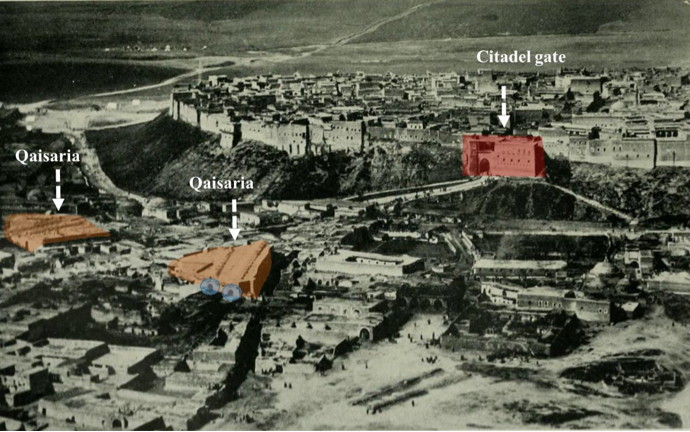
Source: Modified from the R.A.F photograph taken in ca.1918, published in (Hay 1921, p. 116 – by permission of the Air Ministry)
The limited attention paid by architects and urban designers to Erbil’s ancient and medieval history led me to wonder whether this neglect stemmed from a lack of accessible information or from a preference for studying the city’s more recent urban development. This observation encouraged me to delve deeper into the historical layers of Erbil and investigate what this remarkable city might still reveal.
During interviews with architects, historians, and archaeologists, I realised that each discipline possessed valuable knowledge, yet these insights were rarely brought together to create a more comprehensive understanding of the city. Everyone seemed to be working within their own academic sphere.
As I searched for and collected information scattered across Iraq, Turkey, Greece, France, Germany, and the United Kingdom, I discovered that a map frequently used by architectural researchers had been incorrectly dated. It was widely believed to date from 1944; however, through comparative analysis of maps, photographs, and archival sources, I established that it actually dated to the 1918/20.
My immersion in the history of Erbil became so intense that I often found myself dreaming of living within the Citadel itself.
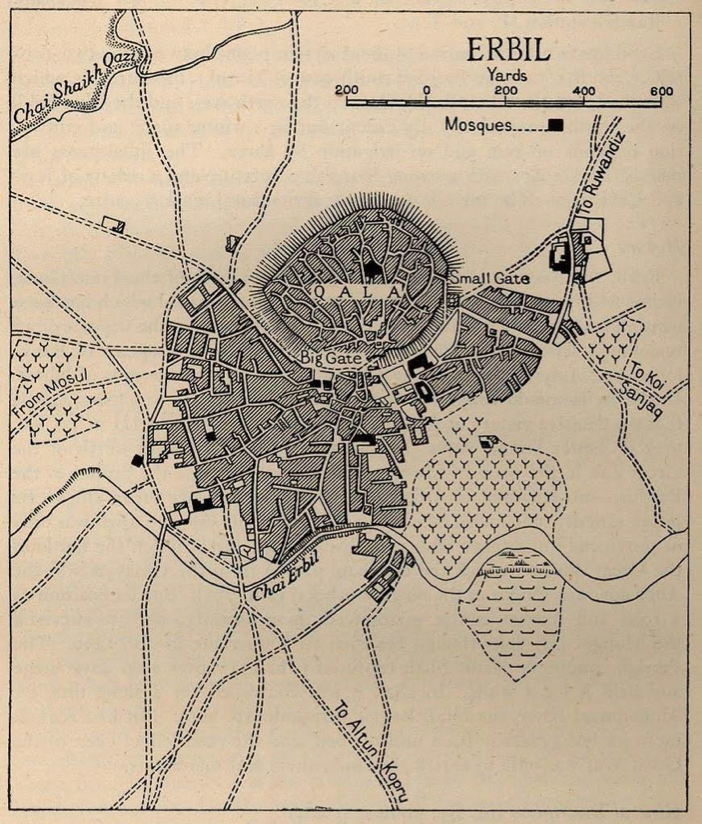
Source: (Great Britain. Naval intelligence Division 1944, p. 530)
This research also required site visits to Erbil, one of the oldest continuously inhabited cities in the world and home to the Citadel of Erbil, which has been inscribed on the UNESCO World Heritage List.
I should note that although I was born and raised in Baghdad, my mother is Kurdish. Had I chosen a city based solely on personal or family connections, I might have focused either on Baghdad, my own birthplace, or on Amadiya (Amedi), my mother’s birthplace, situated on a mountain plateau and renowned for its rich history and growing international recognition. Yet Erbil drew me in for reasons that went beyond personal ties.
Why Erbil?
Apart from the reasons already mentioned, Erbil captivated me because of its unique character. As the capital of the Kurdistan Region, it has become a vibrant and dynamic city that has welcomed people from across Iraq and beyond. Rich in history, its Citadel has endured wars, invasions, and numerous catastrophes, yet it has survived and retained its significance. In many ways, its resilience mirrors that of the Kurdish people themselves, who have struggled throughout history to preserve their language, culture, and identity.
Yaqut Al-Hamawi, who visited the city in13th century, indicated that its inhabitants were Kurds; in fact, they became Arabised as they started to speak Arabic (Akrad lakin ista’rabu). He went to the markets and cafes and heard people were speaking Kurdish and he picked up some words and recorded them in his book [Mu’jam Al-Buldan].
Throughout its long history, Erbil has passed through the hands of many rulers and civilisations. Before the Assyrian period, it formed part of various regional kingdoms. During the Assyrian era, the citadel became associated with the worship of the goddess Ishtar (the goddess of war) and emerged as an important city. Following the fall of Assyria, the city continued to flourish and endure under successive powers and communities, including the Medes, the Hellenistic rulers, the kingdom of Adiabene, Turkmen dynasties, the Mongols, Nestorian Christians, the Kurds, and the Ottomans. Each left its mark on the city, contributing to the rich historical layers that survive today.
Erbil’s Citadel is therefore not merely an archaeological site. It is a living testimony to thousands of years of human settlement, adaptation, and resilience – a place where the histories of different peoples, cultures, religions and empires intersect. It is this extraordinary continuity, together with its capacity for renewal, that continues to fascinate me.
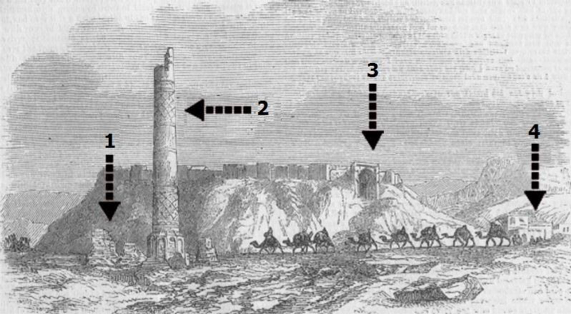
(1) the remains of an old mosque (2) the minaret (3) the main gate, (4) some settlements or buildings.
Source: Adapted from (Illustrated Times 19 September 1857, p. 205), the engraving was originally published in Flandin, and Coste 1843 -1854.
My visit to Erbil in 2015, which was supposed to last only 10 days, extended happily to nearly a month. During that time, I discovered a new and radiant face of beloved Kurdistan: the richness of its history and the depth of its civilisational heritage. This land still holds treasures buried beneath its soil, waiting for someone to excavate and reveal them before they disappear beneath modern construction, vanishing just as many others have vanished before them.
While I was at the Citadel, standing on its southern side overlooking the Erbil Qaysariyah Bazaar and the main square, I stopped to take photographs of the areas below. As I turned towards the Muzaffariya Minaret to capture what I thought would be a beautiful photograph, I was shocked by the sight of a massive structure still under construction behind it.
This building had already caught my attention when I first arrived in Erbil because of its grandeur and elegant simplicity. Yet in this location it had become a disaster for the minaret. Rising directly behind it, the structure stood like a backdrop or a wall, diminishing the minaret’s visual dominance and disrupting the historic visual axis that had defined its presence for centuries.
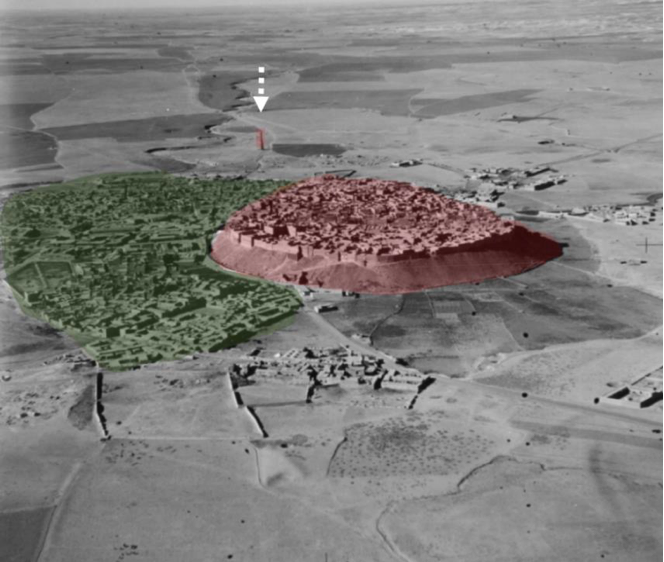
Source: Modified from (RAF photographs taken for Aurel Stein, British Academy: image 13852)
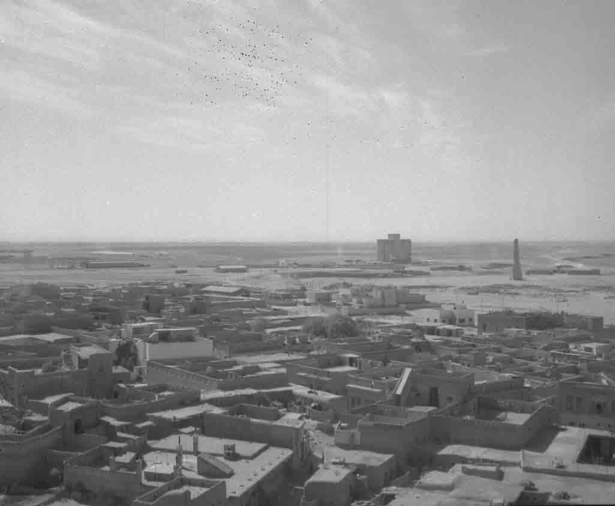
Source: (Doxiadis Archive, 1958; Erbil, P-QA 570 – photograph 30726)
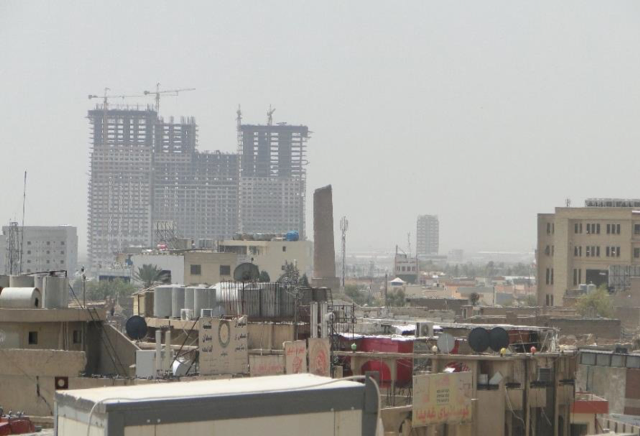
Source: Taken by Farah Al-Hashimi, 2015
As I stood there, saddened and absorbed in documenting this painful transformation, I remembered an article written by my father and published in an Iraqi newspaper. In it, he wrote about Iraq’s palm trees and the damage caused by imported treatments that had left some of them leaning rather than standing tall and straight as they once had. In his article, he imagined hearing a voice filled with sorrow and pain – a voice speaking on behalf of the palms and recounting what had happened to them.
That article remained in my mind. Standing before the minaret, I imagined hearing a similar voice calling to me from afar – a voice filled with grief and longing:
“Farah…
Farah… O daughter of Iraqi Kurdistan, daughter of Amadiya,
Farah… do you see what they have done to me, O daughter of Baghdad?
Do you see that after my brothers and I – the Citadel and the Great Southern Gate -lived for centuries in the imagination of photographers, in the stories of travellers, and in the writings of Orientalists as authentic landmarks of Erbil, celebrated for our beauty, mystery, majesty, and pride?
And now I stand here, sad and alone within the fabric of the city.
Surrounded by parks, houses, flowers, towering buildings, and trees.
Passers-by and admirers photograph me only briefly. I long for my former days.
Farah… do you see this structure behind me?
It stands like a treacherous wall, like a prison barrier that deprives me of the distant horizon.
They have left me here alone,
Surrounded by greenery and newly born grey streets.
Nothing remains to me except my ancient glory.
Farah… I complain to you because I have no one else here.
Carry my words to everyone.
Tell them that the Beauty of Erbil is lonely.
She is sad – and do not forget, people of Erbil, that she is unique…”
I replied while pain gripped my heart:
“O unique Muzaffariya Minaret of Erbil, I am powerless.
You will always remain incomparable.
Forgive us, beautiful and magnificent one.
I will carry your words wherever I go.
I will speak of the Beauty of Erbil across places and across time – lonely, unique, and enduring.”
The Muzaffariya Minaret itself is unique. One of its most remarkable features is the pair of internal staircases that spiral upward without ever meeting. Whether this reflects the ingenuity and creativity of the usta (master builder) – what we would today call the architect – we may never know with certainty. Yet it remains a testament to the skill and imagination of those who built it.
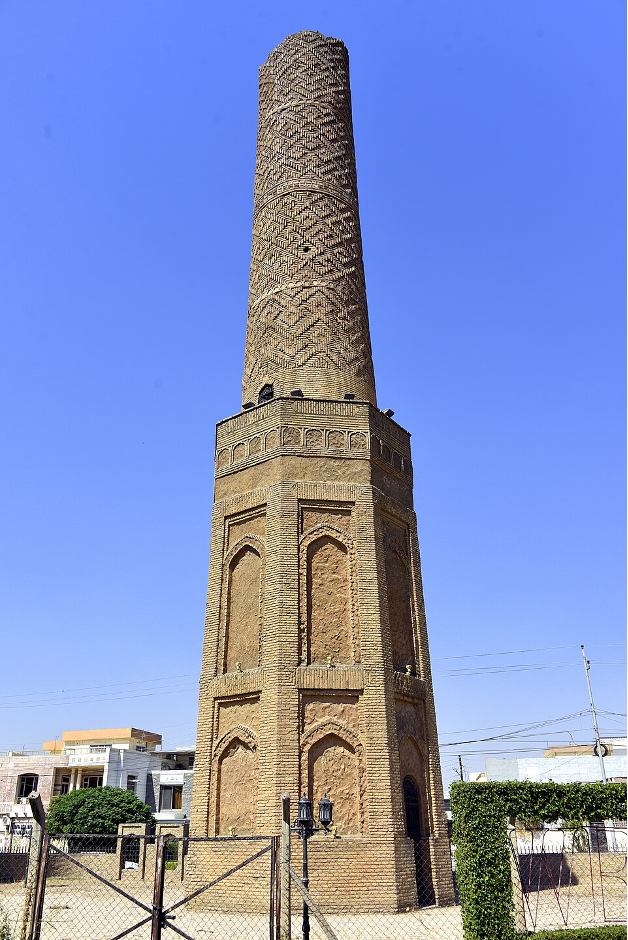
Source: Taken by Dr Osama Shukir Muhammed Amin publishes at
https://en.wikipedia.org/wiki/Mudhafaria_Minaret#/media/File:Mudhafaria_Minaret,_Minaret_Park,_Erbil.jpg
Afterwards, I departed carrying the message that had been entrusted to me.
Soon after, I began speaking publicly about this issue at a seminar organised by the French Institute of the Near East (a term that I still regard as an outdated geographical label – near to whom, exactly?).
The event was attended by a large audience, including representatives from UNESCO, the Director of Erbil Antiquities, the Director of the Iraqi Heritage Conservation Centre, academics from the Departments of Archaeology and Architecture at local universities, and officials responsible for preserving the Citadel.
There, I spoke about the painful transformation inflicted upon the minaret – something that seemed to have escaped the attention of many others.
I raised an important question to the UNESCO representative: Are there regulations governing construction that negatively affects the visual setting of historic monuments and landmarks? Such regulations are essential for preserving the significance and visual prominence of heritage sites. They can help prevent the placement of modern buildings in locations that compromise historic monuments. A new building may be important in its own right and contribute to the city’s development, yet its location can be disastrous for a historic structure standing beside it.
This issue extends far beyond Erbil. It applies to every historic city and every significant monument in Iraq whose meaning is inseparable from its visual setting.
To avoid prolonging this discussion, and to remain realistic, we must acknowledge that little can be done about this particular building now that construction has been completed. And so, I am left, with an aching heart, carrying only my pen.
Words and writings may seem powerless, yet perhaps they can still reach someone. Perhaps they can inspire action to protect what remains of our tangible heritage and our history, so that we may preserve it for the generations yet to come.
Dr Farah Al-Hashimi, June 2026 – London